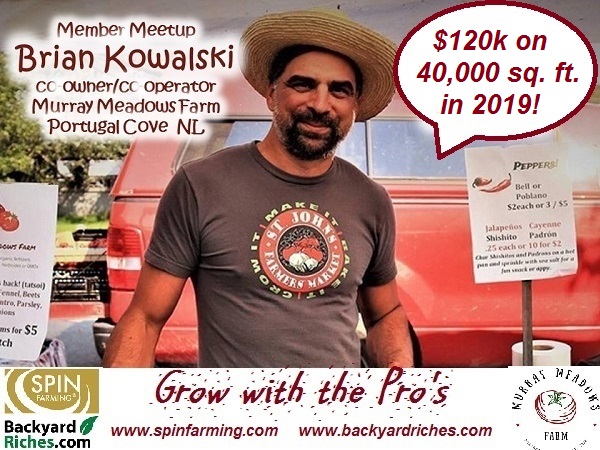
WHEN: July 25, 2pm ET
WHERE: online
REGISTER: Members can register here
Courtesy of Roxanne C., Philadelphia PA
The story of the aging American farmer is getting old. Every time a new agricultural census report is released it documents how the age of farmers is rising. According to results of the latest census, the average age of primary producers increased from 58.3 in 2012 to 59.4 in 2017.
This is the reality that has been captured by the census for the past 30 years. The average age of U.S. farmers has grown by nearly eight years, from 50.5 years to 58.3 years. The conclusion is that fewer individuals are choosing farming as an occupation than before. This elicits the same well-worn response from advocacy groups, media and the industry that bemoan the barriers to entry for new farmers: inability to access farmland and high cost of startup capital. This reality is concerning to the profession for good reasons, but it’s discouraging people from entering the profession for bad ones.
Land and money don’t have to be the insurmountable challenges the status quo make them out to be. SPIN farmers start in backyards, either their own or others, or find other unused space. They start generating cashflow within the first few months. Once they they have mastered production and established a customer base using garden-size plots, they can expand to a half acre, and then multiple acres, continuing to fine tune their systems, expand their markets and increase their investment as they go.
Over a dozen years of training SPIN farmers, this is the reality we see. Some practice SPIN in their backyards in the city. Others do it on front lawns in the suburbs. Still others do it on large acreages in the country. Some do it part-time, others full-time, alone or with family and friends. Some are young and just starting out, while others are older and on their third or fourth careers, or starting a lifestyle business in retirement. Some have more money than they know what to do with, and others have less than they need.They span geographies, generations and circumstances.
Here’s what they do have in common: they’re looking for a business opportunity they can develop right in their own backyard. They like working outdoors, they like physical work, they like the idea of producing a product everyone wants and needs, they see lots of people flocking to the farmer’s market and owner/operated restaurants, and lugging around CSA boxes and they decide to try growing food to make some money. This is SPIN-Farming’s alternate reality, and it’s creating a working alternative for those who, at any age, are willing to defy worn-out expectations.
LEARN OTHER WAYS THAT WORK BETTER THAN CONVENTIONAL FARMING PRACTICES IN THE SPIN ONLINE SUPPORT GROUP. FREE TRIAL MEMBERSHIP WHEN YOU PURCHASE ANY SPIN GUIDE.
Courtesy of Roxanne C., Philadelphia PA
Beginning urban farmers eager to demonstrate their commitment to sustainability include rainwater harvesting in their startup plans. Once they start implementing, they usually find that what sounds good in theory doesn’t work well in practice.
The first downside is the expense in gear – pipes, tanks, fittings. Second is the quality of the water, which is run-off from the roofs of nearby buildings and paved surfaces. Since this can contain bird droppings and contaminants, testing, filtration and treatment of the water is required. Then, because the water collected sits and becomes stagnant, further treatment is required for algae and mosquitoes. After all the effort and expense they’ve built themselves a water source that’s unpredictable and barely amounts to a drop in the bucket.
Over the years, cities have built elaborate systems to deliver potable water whenever it’s needed. Those farmers who, through necessity or strategy, are starting their businesses surrounded by concrete, should consider access to municipal water an advantage and not try and re-invent the wheel.

There’s gotta be a better way than this!
Yeah, there is.
LEARN OTHER WAYS THAT WORK BETTER THAN CONVENTIONAL FARMING PRACTICES IN THE SPIN ONLINE SUPPORT GROUP. FREE TRIAL MEMBERSHIP WHEN YOU PURCHASE ANY SPIN GUIDE.
Courtesy of Roxanne C., Philadelphia PA
A post to the SPIN farmer online support group asks, “My home state has an interesting political environment after the elections that has led many people looking for an exit. Not getting political, just looking at options before my wallet is attacked. Has anyone moved their farm?”
For SPIN farmers it’s a straightforward question. Many don’t own much, or any, of the land they farm. SPIN’s production methods are portable and can be adapted to any climate. SPIN’s infrastructure is movable or easily replaceable. So it’s quite feasible to change the shape and size of a farm in response to a range of pressures, possibilities and life changes.
A new SPIN farm can be brought online rapidly. There will be soil and weed issues, as well as acclimating to a different seasonal time frame, but that’s pretty manageable using SPIN’s production segments and relays. Longer season crops is where the main adjustments will need to be made.
The biggest loss is your customer base that has taken time to develop. Researching the market potential of greener pastures done online will give you an idea of what the new market opportunities or limitations will be. You can anticipate being more dependent on outside income for the first couple of years while you re-invest in market development, but with your experience managing what you’ve been doing, the production and operations end of your farm will come into line rapidly.
Soil building also takes time and does represent sweat equity,but farming is, at its root, an ad hoc and adaptive process. When life, economics or politics compel you to pull up stakes, two of your most important farm assets – SPIN knowledge and infrastructure – can be packed up and taken with you.

LEARN FROM PIONEERING SPIN FARMERS WHO ARE TAKING THEIR BUSINESSES TO NEW AND UNCHARTED PLACES IN THE SPIN ONLINE SUPPORT GROUP. FREE TRIAL MEMBERSHIP WHEN YOU PURCHASE ANY SPIN GUIDE.
Courtesy of Roxanne C., Philadelphia PA
Farm tours are a hot ticket these days, especially ones that offer entertainment. Many SPIN farmers are hard pressed to provide hay rides, and their plots don’t provide an Instagram-ready backdrop for weddings. But they do show people how to make significant money growing crops in their backyards.Even those who are already familar with the concept of backyard commercial farming are astonished when they visit SPIN farms. Here’s some of the thrills and surprises in store.
So where is the farm? You are at it, on it and in it. It sometimes consists not only of the front and back yards, but also the garage, basement, sometimes a few greenhouses. Those who visit multi-locational SPIN farms also get some nice tours of several neighborhoods.
Where are the weeds? SPIN farms are disappointing in that regard. There really aren’t many. SPIN farmers pend about 6 hours a week initially weeding their various plots, and towards the end of the season they really don’t have to spend any time weeding at all. SPIN’s intensive production makes it hard for weeds to become established, so SPIN farmers really don’t have to pay them much mind.
Where is the compost pile? Out of respect for the neighbors, SPIN farmers compost very discretely, so their bins don’t have pride of place. They usually aren’t very big anyway because there is very little waste at backyard-scale SPIN farms to compost.
What’s the secret to the soil? Many SPIN farmers have been working many of their plots for many years and even though they are planted intensively, they really don’t have an exotic secret sauce to maintaining their soil. They spot fertilize just specific plots when they need it, depending on what is grown. At SPIN scale, they can micro-manage my soil, so it turns out to be not much maintenance at all.
The drive time to market is just 5 minutes? Yes, for some lucky SPIN farmers, they just roll out of bed, and they are there. For others they may have to drive across town or to the next town over. But under an hour is usually the norm.
But that’s not easy enough? Not for some.They have to haul produce from the car and keep it cool with ice packs. That takes time and can be onerous, especially if you have multiple markets per week. So some develop an online business to diversify and make delivery and fulfillment easier. It also allows them to match supply to demand precisely and develop close and lasting relationships with their customers. .
You use a tiller? SPIN farmers know tilling is controversial, and any discussion about it quickly morphs into big questions about the meaning of life, and the universe. It’s best discussed in a bar over a few cold ones, rather than at the farm. The farm to glass movement is starting to bear fruit so hops looks to be an interesting niche crop to develop if you have the right conditions. Combining a brewery with a SPIN farm does have its appeal.

Ah, this is it? SPIN farm tours can get crowded.
TAKE A BEHIND THE SCENES TOUR OF A DIFFERENT PROFITABLE BACKYARD FARM EVERY MONTH IN THE SPIN ONLINE SUPPORT GROUP.GET A FREE TRIAL MEMBERSHIP WITH THE PURCHASE OF ANY SPIN GUIDE.
Courtesy of Roxanne C., Philadelphia, PA
Cutting out the middleman so SPIN farmers put more money in their own pockets was the business model we all started with 10+ years ago. Now, due to the rise of a new food culture, a growing number of grocery shoppers – those don’t have the time to shop farmers markets, don’t want to commit to a CSA, and don’t need to get up close and personal with a farmer – are deciding that eating healthy is worth it, and worth the higher price.
This willingness to pay the real cost of fresh local food is starting to percolate through the supply chain. New-style online grocery delivery services, as well as old-line supermarkets and distributors, are now both vying to serve this new enlightened consumer. But the logistics and economics of large scale food distribution are much the same as they ever were: to maximize efficiency and profitability, buy as much from as few as possible. This was what drove down the cost of food when consumers wanted food cheap, and gave us the supply chain we’re trying to re-engineer.
Now that more consumers want local, and are willing to pay a bit more for it, large scale food distributors are investing in new systems to accommodate the demand. They are open to considering new suppliers, so SPIN farmers now have the opportunity to think bigger. You,too, will need to re-examine how you operate and calculate the tradeoffs between classic SPIN, based on widely diversified production, direct marketing and
premium pricing; and scaled up SPIN that requires specialized production, reliance on a middleman to sell crops, and wholesale pricing.
For one to be right, the other does not have to be wrong, and SPIN farmers can even do both at the same time. You can continue SPIN’s diversified production and direct marketing on part of their farm, while scaling up on one or just a few crops on a larger area of their farm. The mix of diversification, specialization, scale and business models can change over time, to fit you, your circumstances and markets.
Eliminating barriers has always been SPIN’s stock in trade, including mental ones. While small may be beautiful, and a direct connection between farmer and consumer can be fulfilling for both, there is a new opportunity for those who are ready to expand their thinking beyond the CSA and farmers market. Which SPIN model makes sense for you? Classic or Scaled up? Both? The option is yours.

Local limits volume and introduces inefficiencies but the cost can be passed on to the consumer. Small is beautiful when it’s profitable. Scaling up can be beautiful too, if you can do it without killing yourself. That means figuring out different workflow, logistics and economics.
FIND OUT HOW THOSE WHO PIONEERED SPIN-FARMING ARE NOW TAKING IT TO NEW LEVELS IN THE SPIN ONLINE SUPPORT GROUP. FREE TRIAL MEMBERSHIP WHEN YOU PURCHASE ANY SPIN GUIDE.
Courtesy of Wally S., Wally’s Market Garden, Pleasantdale SK
This is a burning question among new and experienced SPIN farmers alike.Get ready for the answer that drives everyone inside and outside of farming crazy: It depends. Your choice of irrigation will depend on lots of factors, including your type of soil and operation.
I use hand watering methods most of the time. I am not a big fan of mechanized systems and specialized hoses because they are expensive and require management and maintenance. They might make you feel clever, but if you analyze the effort that goes into them, you might find they don’t really earn their keep.
Another factor to consider is potable water. Many of you know my story, and that a big reason for my becoming an urban farmer was to ditch my expensive and elaborate irrigation system that depended on fluctuating river levels. Now, I just turn on the tap. Potable water is the single most important issue when selling produce that is eaten fresh, because water can be the source of contamination, and using municipal water greatly reduces this risk.
Below is how I handle it for my multi-locational an urban/peri-urban 11,000 sq.ft. farm. But just because I prefer to hand water doesn’t mean other methods are not viable. These are the broad categories of crops just as a starting point.
IRRIGATION METHODS FOR SPECIFIC CROPS
Carrots > > Overhead for germination > > Flood irrigate during growing stage
Cucumbers > > Overhead hand water with brush attachment around the plant
Leafy greens: Lettuce, chard, spinach, others > > Flood irrigate by letting the hose with brush attachment lay on the ground. Move around to cover area. (mostly). > > Overhead hand watering (sometimes)
Night shades: Potatoes, tomatoes, peppers, egg plant >> Flood irrigate > > Do no use overhead since it can cause disease issues with these crops
Pumpkin > > Overhead, hand water with brush attachment around the plant
Summer squash > > Overhead, hand water with brush attachment around the plant
Winter squash > > Overhead, hand water with brush attachment around the plant
Pumpkin > > Overhead, hand water with brush attachment around the plant
Radish > > Overhead hand water with brush attachment
Fresh herbs > > Overhead, hand water > > Dryland

Wally’s approach to irrigation is to keep it simple. He hand waters, mostly.
LEARN ABOUT MORE SIMPLE WAYS TO START AND OPERATE A BACKYARD FARM IN THE SPIN ONLINE SUPPORT GROUP. FREE TRIAL MEMBERSHIP WHEN YOU PURCHASE ANY SPIN GUIDE.