The #1 rookie planting mistake: using templates. They don’t work. Here’s why: timing. Planting dates you plan in theory don’t work out in practice. Blindly following a template results in too much production all at once, overlapping harvests, wasted crops, inflated revenue targets, missed opportunities.
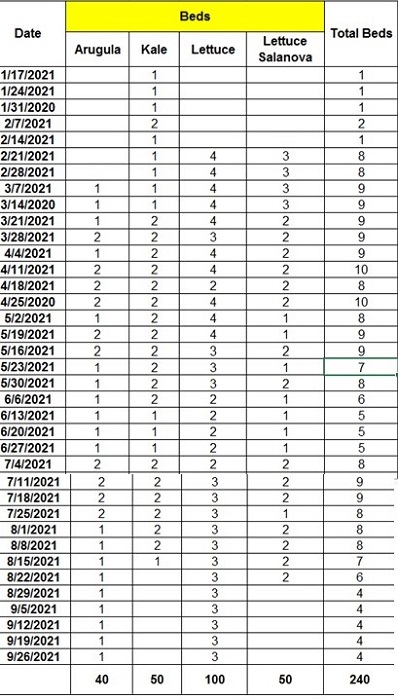
Look at the above templated plan. It has weekly plantings of crops. Many of those plantings will run into each other because the dates don’t mean the crops will be ready to harvest in the projected time frames. Why? Unpredictable and uneven germination. Many of these plantings will end up coinciding.
What is needed is staggered plantings of 2-3 weeks. To put in a proper stagger, you can’t rely on template dates. Your planned template plantings and the reality on the ground frequently diverge. For the above plan, there needs to be at least 2 – 3 weeks between plantings. Arugula is a quick turn crop that is finished in under two months. So it offers relay potential to other crops, which would allow this farmer to diversify his crop repertoire. Since he is just starting out, crop diversification is a good way to hedge his bets if he can’t find markets for the 4 crops he has selected in the yields he projects. A short list he might want to consider:
– beets
– beans (green and yellow)
– carrots
– chard
– cucumbers
– cilantro
– garlic
– onions
– tomatoes
And what about those yields? They are way too optimistic for an initial growing season – they should be cut by half. Whether or not he can do this all on 20,000 sq. ft. which is what he is planning, is a discussion for another day. The point here is you will set yourself up for failure by believing that planting plans are plug and play, and that you can achieve success on auto pilot. The reality is you can’t short circuit the learning process or substitute a form for understanding.
Instead, get what smart farmers use instead here.